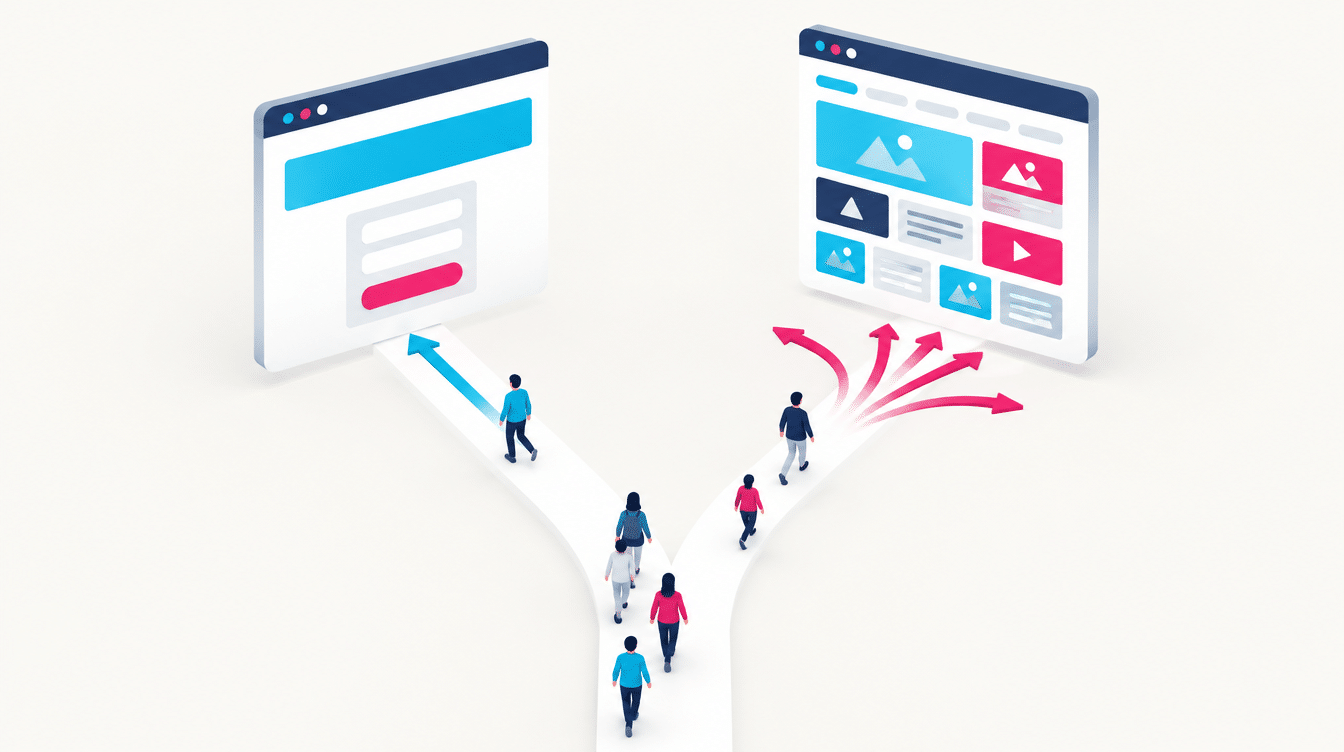
You paid for the click. Someone searched “AC installation in Holon” (a city just south of Tel Aviv), saw your ad and tapped it. Now everything hinges on one question: where did that visitor land? That’s what decides whether you get your money back. A lot of businesses send all their campaign traffic to the homepage because it’s the easiest option. Then the campaign turns out expensive and brings in no leads.
What’s the difference between a landing page and a homepage?
Your homepage speaks to everyone: new customers, existing customers, job seekers, a supplier looking for your phone number. It has a menu, several services, a bit about the company, and visitors pick their own next step. A landing page is the opposite. You build it for one campaign and one offer, and the only things a visitor can do there are leave their details, call or buy.
When is a landing page the better choice?
When the campaign offers one clear thing. Someone who searched “AC installation in Holon” and landed on an air-conditioning company’s homepage now has to dig on their own: where’s the installation info, do you even cover Holon, how much does it cost. Most people won’t dig. They’ll go back to Google and tap the next ad, and you’ve already paid for the visit.
On a landing page, the headline already says “AC installation in Holon, we’re there within 48 hours.” Below it: a price, three testimonials and a form asking for name and phone. The visitor doesn’t have to look for anything.
It also affects what you pay per click. In a Google Ads campaign, every keyword gets a Quality Score, and one of its three components is landing page experience: how relevant the page is to what the person searched for, and how easy it is to use. A page that matches the search exactly raises the score, and when the score is high, you usually pay less per click. On Facebook and Instagram the logic is similar: someone who stopped scrolling for a specific ad needs to see the same thing on the page they land on.

And when is a regular site page better?
You don’t always need a landing page. In these situations, a regular page on your site works better:
In this whole list, the homepage shows up only once. There’s almost always a page on your site that fits the search better.
Where should you build the page: on your site or in a separate tool?
Both work, but in most cases it’s better for the page to be part of your site. It sits on your domain, just without the menu and footer, and the visitor sees the same name and logo they saw in the ad. Tracking is simpler too, because everything already connected to the site works on the page as well.
An external page builder makes sense when you need to go live tomorrow morning and nobody is available to touch the site. The catch is that you then have to reconnect tracking and forms, and check that the leads reach the same place as all your other inquiries. And before the campaign goes live, fill in the form once yourself and check that the lead actually arrived.
So which should you choose?
A campaign with one offer for one audience: a landing page. A search for your business name, a store with a catalog, a service people need to read about and compare: the best-matching page on your site.
And if you don’t have the time or budget for a landing page right now, still don’t send people to the homepage. Send them to the relevant service page and put a form at the top. It’s not ideal, but it’s much better than the homepage.
A five-minute check: where your ads send people today
Open the ads in your ad account and check where each one points, in the “Final URL” field. Then open that address on your phone, as if you’d tapped the ad. Does the headline repeat what you promised in the ad? Can you see a form or a button without scrolling? Finally, go to the “Landing page” report in GA4 and check how many of the visitors who came from the campaign left their details.
What does a landing page need in order to bring in leads?
A bad landing page is worth even less than your homepage. Before you launch a campaign, check that the page has all of these:
Here’s how it works at DreamZone: we build our landing pages for businesses together with the campaign, not after it, so the ad, the headline and the form all match. A page like this goes live within one to two weeks, already connected to tracking, and once data builds up we test a second version against the first.
Paying for clicks and not getting leads?
We’ll check where your campaign sends visitors today and build a landing page that matches your ads. Leave your details and we’ll get back to you.
Questions we get about landing pages
Can I use the same landing page for Google and Facebook?
You can, but it’s better to keep them separate. Someone who came from Google searched for the service and wants details and a price. Someone who came from Facebook wasn’t searching for anything, so the page first has to explain why this is relevant to them at all. With two pages, it’s also easier to see which channel brings in leads.
Can a landing page also show up in Google’s regular results?
It can, but that’s not its job. It’s short, it talks about one thing, and sometimes it competes with the service page you already have on the site. That’s why we often ask Google not to index it, and leave organic SEO to the site’s regular pages.
How many landing pages does a campaign need?
Start with one. Add a page when you advertise something else or target a different audience: another service, another city, a promotion. A page for every keyword is overkill, and one page for five different services is too little.

Dan Komem is the founder of DreamZone, an Israeli digital agency operating since 2015. He holds a BA from Reichman University and has 25 years of experience in web development and marketing. He specializes in website development, SEO, paid advertising on Google and Meta, AI-powered marketing automation and analytics, and helps businesses build a digital presence that brings in customers.
Dan Komem on LinkedIn →