
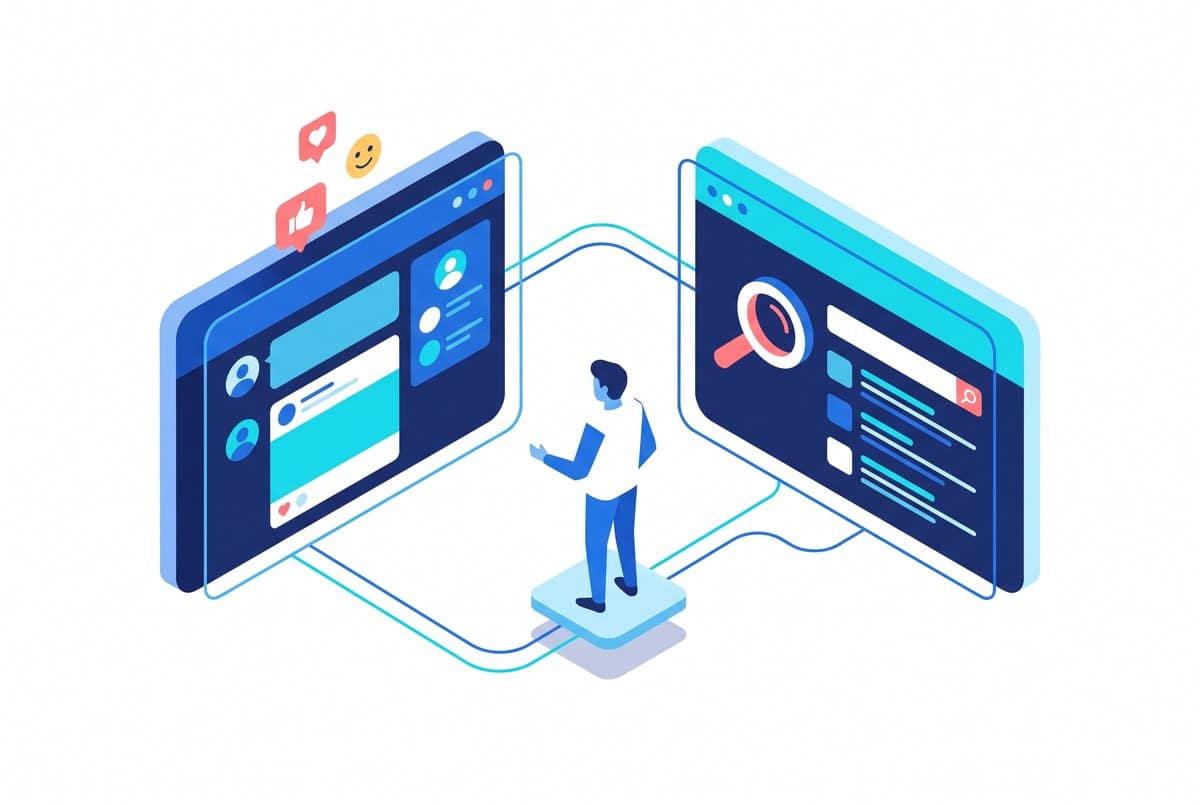
A business Facebook page with thousands of followers won’t move your website up in Google. Some people still think it does, but Google doesn’t count likes and followers when it decides which sites to show.
So when people talk about promoting a website on Facebook today, they really mean something else: bringing people from the feed who actually fit your business, straight to a page that speaks to them, and knowing which of them left their details. That’s where Facebook is strong, and that’s where your budget should go.
Posts or ads?
A post on your business page reaches only a small share of your followers these days, and it reaches new people only when the algorithm decides to recommend it. It’s good for people who already know you: to see the business is active, read reviews, hear about a sale. New traffic to your site almost always comes from ads.
In Meta Ads Manager (the same campaign also runs on Instagram), the first thing you pick is the campaign objective, and that’s the decision with the biggest effect on results. A “Traffic” objective brings lots of cheap clicks, but the system looks for people who tend to click, not people who tend to leave their details. A “Leads” or “Sales” objective looks for people with a good chance of contacting you, and that’s usually what a business needs.
What about targeting? People used to spend hours picking interests. Today Meta’s system mostly finds the audience on its own, based on who engaged with your ads and who left their details. What really steers it is the ad itself: the image, the first line and the offer. An ad aimed at restaurant owners will attract restaurant owners.
When leads come in through your website, Facebook needs to know who filled in a form. That’s why you install the Meta pixel on the site and set up a form-submission event. Without it, the system is working half blind.
“Facebook won’t lift you in Google. It brings people to your site who didn’t know yet that they need you.”

Three things that decide whether a click is worth anything
Where the click leads. An ad about a sale that leads to your homepage wastes the click. Send people to a page about exactly what the ad promised, with a short form they can see without scrolling. We covered this in detail in “Landing page or homepage?”
What you measure. Click counts don’t pay salaries. Measure leads: how many forms, how many calls, and what each lead cost. Browsers block part of the tracking these days, so it’s worth connecting the Conversions API too, which reports to Facebook straight from your server. We explained how it works in our guide to conversion tracking without cookies.
What happens to people who didn’t leave their details. Most people who arrive from an ad don’t leave details on the first visit. If you build an audience of site visitors, you can show them a different ad in the days after their visit, like a client review or an answer to the question that stopped them. We wrote about this, and a few other common mistakes, in our piece on remarketing myths.
And the business page itself? It still matters, just for a different reason: people who saw your ad go check you out. A page with recent posts, real photos and comments someone actually answered is more convincing than any ad. We have a separate guide on managing Facebook pages.
We run Facebook and Instagram campaigns for businesses, and every campaign starts with one question: what counts as a lead for you? Only then do we pick the audience and the ads.
What does a lead from Facebook cost you?
We’ll go through your ad account and show you where the money goes. Leave your details.
Two more questions
Should I send people to my site or use a Facebook form?
A form inside Facebook (Lead Ads) is quick to fill in because some of the details are already pre-filled, so a lead through it is usually cheaper. On the other hand, some of those leads are less serious, because it’s so easy to leave details that nobody thinks twice. When the product needs explaining or involves a big decision, sending people to the site filters better. It’s worth trying both and comparing how many leads turned into customers.
What’s the minimum budget worth starting with?
There’s no single number, but there’s a useful rule: Meta needs roughly 50 conversions a week per ad set to get out of the learning phase. If your budget is too small to get there, work with fewer ad sets and pick a more frequent action as the conversion, like a WhatsApp message instead of a long form.

Dan Komem is the founder of DreamZone, an Israeli digital agency operating since 2015. He holds a BA from Reichman University and has 25 years of experience in web development and marketing. He specializes in website development, SEO, paid advertising on Google and Meta, AI-powered marketing automation and analytics, and helps businesses build a digital presence that brings in customers.
Dan Komem on LinkedIn →

Related Articles

The phone rings. Someone wants a quote, and at the end of the call you ask how they found
For three months now you’ve been paying a company to run your Google Ads. Every month a re

Friday, 1 p.m. Someone sends you a WhatsApp: “Hi, can I get a quote for an installation?”